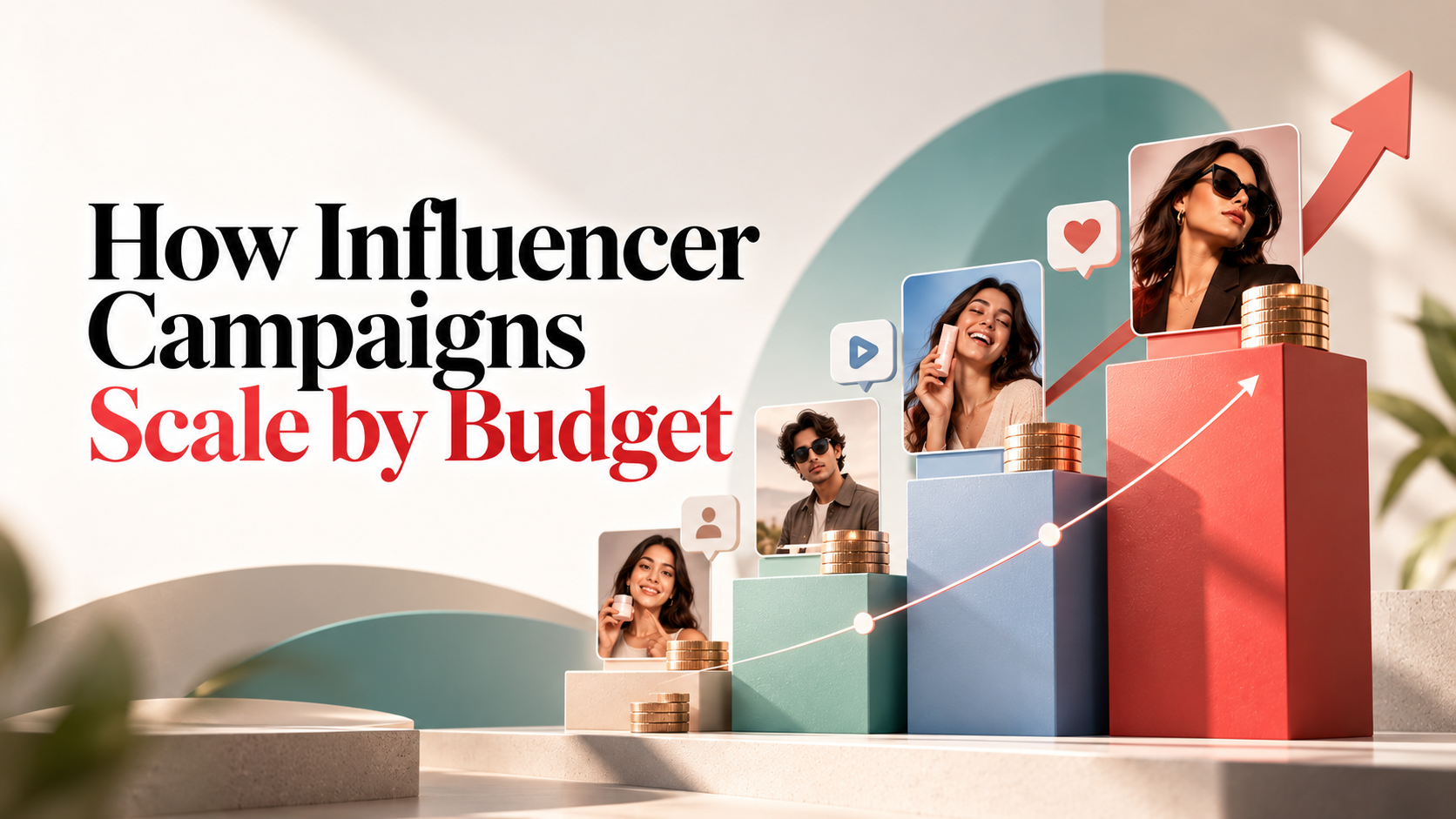
A ₹5 lakh influencer marketing budget looks different from ₹1 crore. Not just in reach and frequency, but in structure, strategy, and what you can realistically expect. Many brands make the same mistake regardless of budget: they chase one or two big creators instead of building a portfolio of consistent, trackable performance. But at ₹5 lakh, that's a bankruptcy move. At ₹1 crore, that's a missed opportunity.
Here's how influencer campaigns actually scale at three distinct budget levels, and what to do with each.
At ₹5 Lakh: Micro-Influencer Portfolio Strategy
₹5 lakh is your first serious influencer marketing investment. This isn't gifting-only territory anymore. But it's also not macro-influencer money. This budget demands focus on micro-influencers (10,000-100,000 followers) with high engagement rates.
Budget breakdown:
- Creator fees: ₹3.5 lakh (70%)
- Paid amplification and spark ads: ₹1 lakh (20%)
- Tools, tracking, management: ₹50,000 (10%)
With ₹3.5 lakh in creator fees at this tier, you can activate 25-35 micro-influencers at ₹8,000-₹15,000 per post. This is the high-ROI zone. Micro-influencers deliver 3-5x ROI because their audiences are deeply engaged and trusting, not just passively following.
What you'll get:
Total reach: 2-3 million impressions across posts. Engagement: 4,000-7,000 interactions (likes, comments, saves, shares). Conversions: 150-250 customers depending on product category and average order value. Cost per acquisition: ₹2,000-₹3,000 if managed well, or ₹4,000-₹6,000 if creator selection is poor.
The single biggest mistake at this budget level is spreading too thin. Don't activate 100 nano-influencers at ₹2,000 each. Their reach is small and their engagement is unreliable. Instead, concentrate budget on 20-30 vetted micro-influencers who have demonstrated category fit and high engagement in the past.
Campaign structure:
- Months 1-2: Activate 25 creators with 1 post each. Measure which creators drive traffic and conversions.
- Months 3: Double down on the top 10 performers. Have them post again with improved briefs based on what worked.
- Month 4: Test 10 new creators in adjacent niches to expand reach.
Repurpose every single piece of content. Take the top 3-5 performing posts and run them as spark ads on Instagram. This costs ₹20,000-₹30,000 but can generate an additional ₹1.5-₹2.5 lakh in revenue because influencer-created content outperforms brand-generated creative by 2-3x.
At ₹25 Lakh: Micro + Mid-Tier Blend
₹25 lakh is where you can sustain a consistent always-on program, not just a campaign. You're now activating 15-20 creators every month continuously, not as a one-time push.
Budget breakdown:
- Creator fees: ₹17.5 lakh (70%)
- Paid amplification: ₹5 lakh (20%)
- Tools, management, overhead: ₹2.5 lakh (10%)
At this level, your creator mix becomes strategic:
- 60% micro-influencers (₹8,000-₹25,000 per post): 12-15 creators
- 30% mid-tier influencers (₹40,000-₹1,50,000 per post): 4-5 creators
- 10% nano-influencers for UGC and seeding (₹2,000-₹5,000 per post): 5-10 creators
What you'll get:
Monthly reach: 8-12 million impressions (sustainable across the month). Monthly conversions: 400-600 new customers depending on category. Cost per acquisition: ₹1,500-₹2,500 at scale. Monthly content assets: 15-20 original posts, plus 3-5 repurposed as paid ads.
At ₹25 lakh, you move from "testing" mode to "building a channel" mode. Brands like Mamaearth and boAt operate at this level continuously. They don't run seasonal campaigns. They run an always-on influencer engine with 15-20 creators posting every week. The constant drumbeat of content builds social proof that no single campaign can match.
Key difference from the ₹5 lakh tier:
At ₹5 lakh, you're optimizing for ROI per creator. You activate 25-30 micro-influencers once, measure results, scale winners. At ₹25 lakh, you're optimizing for consistency and portfolio depth. You activate 60-70 creators per quarter across three tiers, rotate them throughout the month, and measure cohort performance, not individual creator performance.
Campaign structure:
- Month 1: Activate Cohort A (15 creators across tiers, 1 post each)
- Month 2: Activate Cohort B (15 different creators)
- Month 3: Activate Cohort C (15 different creators, but include 5 repeat performers from Cohort A)
- Month 4: Repeat the cycle with audience insights from months 1-3
At ₹25 lakh, paid amplification budget becomes meaningful. Take 4-5 top-performing organic posts and run them as spark ads. Your media spend of ₹5 lakh per month can drive incremental revenue of ₹15-₹20 lakh because influencer-created content converts at 2-3x the rate of brand-generated content.
At ₹1 Crore: Full Ecosystem Strategy
₹1 crore monthly means you're operating like boAt, not like a growing D2C brand. You have the budget to build a complete influencer ecosystem, not just activate creators.
Budget breakdown:
- Creator fees: ₹70 lakh (70%)
- Paid amplification and media: ₹20 lakh (20%)
- Agency fees, tools, management, overhead: ₹10 lakh (10%)
At this scale, creator mix becomes:
- 50% micro-influencers (₹8,000-₹40,000 per post): 70-80 creators
- 30% mid-tier influencers (₹50,000-₹2,00,000 per post): 20-25 creators
- 15% macro-influencers (₹2,00,000-₹8,00,000 per post): 3-5 creators
- 5% nano-influencers and UGC (₹2,000-₹10,000 per post): 20-30 creators
What you'll get:
Monthly reach: 50-80 million impressions. Monthly conversions: 2,500-4,000 new customers depending on category. Cost per acquisition: ₹1,000-₹2,000. Monthly content assets: 100-120 posts produced, 15-20 repurposed as paid ads.
At ₹1 crore monthly, you're essentially operating 200+ creators continuously. Some post weekly, some post monthly. The goal shifts from "drive sales" to "own the category narrative." A brand with 200 creators posting about them every week is the category leader in consumer mindshare—before paid ads or SEO even enters the conversation.
The paid amplification game changes:
At ₹20 lakh monthly media spend, you're not just amplifying top posts. You're running sophisticated whitelisted campaigns: taking creator content, removing brand logos, and running it as native-looking ads. These campaigns convert at 3-5x higher rates than typical brand-created ads because they look like peer recommendations, not ads. Your ₹20 lakh in media spend can generate ₹60-₹1 crore in attributed revenue.
Campaign structure:
- Month 1-3: Build creator network across all tiers. Lock in performance benchmarks for each tier.
- Month 4+: Run always-on program with 120+ creator posts monthly. Segment by platform, audience geography, content format.
- Quarterly: Launch 2-3 major category moments (product launches, seasonal peaks) with coordinated 50+ creator activations per moment.
At ₹1 crore, you can afford to experiment. Allocate 10-15% of budget to testing new creator tiers, new platforms (YouTube, Josh, ShareChat), or new content formats (long-form, Reels, Shorts). Test results inform next quarter's strategy. By quarter 4, you've identified which creator segments and formats drive the highest ROI, and you scale those insights dramatically in the next year.
Key Scaling Lessons Across All Three Levels
Lesson 1: More creators beat bigger creators.
A ₹5 lakh budget split across 25 micro-influencers delivers 3-5x more total engagement and 4-6x more conversions than the same budget spent on one macro-influencer. This holds at ₹25 lakh (60-70 creators) and ₹1 crore (200+ creators). The engagement-per-rupee at the micro-tier is simply superior.
Lesson 2: Repurposed content multiplies ROI.
At ₹5 lakh, taking your best 3 posts and running them as spark ads adds 30-50% incremental revenue for 10% additional media spend. At ₹1 crore, this effect scales dramatically. A ₹20 lakh media budget amplifying 20 top-performing organic posts can drive ₹60-₹1 crore in attributed revenue. Content repurposing is where influencer marketing's true economics emerge.
Lesson 3: Consistency matters more than frequency.
A brand that activates 15-20 creators every single month performs better than one that activates 50 creators once. Always-on campaigns build category ownership. Seasonal pushes feel desperate. At ₹5 lakh, run 1 cycle per quarter. At ₹25 lakh, run 4 cycles per year (one per quarter). At ₹1 crore, run always-on with seasonal amplification.
Lesson 4: Tier allocation shifts with scale.
At ₹5 lakh, 80-90% of budget goes to micro-influencers. At ₹25 lakh, 60% to micro, 30% to mid-tier, 10% to nano. At ₹1 crore, 50% micro, 30% mid-tier, 15% macro, 5% nano. As budget grows, you add tiers, not because bigger creators are better (they aren't), but because they solve different business problems: micro drives conversions, mid-tier builds credibility, macro drives awareness among cold audiences.
The mistake most brands make is scaling budget without scaling structure. They add budget but keep activating the same 3-4 creators. That's how you burn through ₹1 crore and wonder why you didn't hit targets.
How To Know When To Move Between Tiers
Move from ₹5 lakh to ₹25 lakh when your best 5-10 micro-influencers are consistently hitting 2-3x ROI. These are proven. Expand the program to 60-70 creators rather than deepening spend on the same ones. More creators at stable ROI outpaces fewer creators at declining ROI.
Move from ₹25 lakh to ₹1 crore when you've built a micro-influencer foundation that's profitable, and you're ready to add mid-tier and macro creators for category reach and credibility. Don't jump directly to ₹1 crore without first proving unit economics at ₹25 lakh. Many brands collapse scaling because they skip the middle tier and jump from micro to mega.
Every rupee of influencer marketing budget should be spent on creators you've already proven, or testing new creators at 20% of budget while scaling proven ones at 80%. This is the 80/20 rule applied to budget allocation. Violate it, and you'll waste money regardless of whether your budget is ₹5 lakh or ₹1 crore.
What's your current influencer budget, and at which tier are you activating creators? Fame Keeda builds custom influencer programs for each budget level, structures creator portfolios for maximum portfolio depth and performance tracking, and helps brands scale budgets without scaling waste. Whether you're deploying ₹5 lakh for the first time or optimizing a ₹1 crore annual program, the right creator mix, consistent activation, and aggressive content repurposing determine whether your budget generates 2x ROI or 6x ROI.