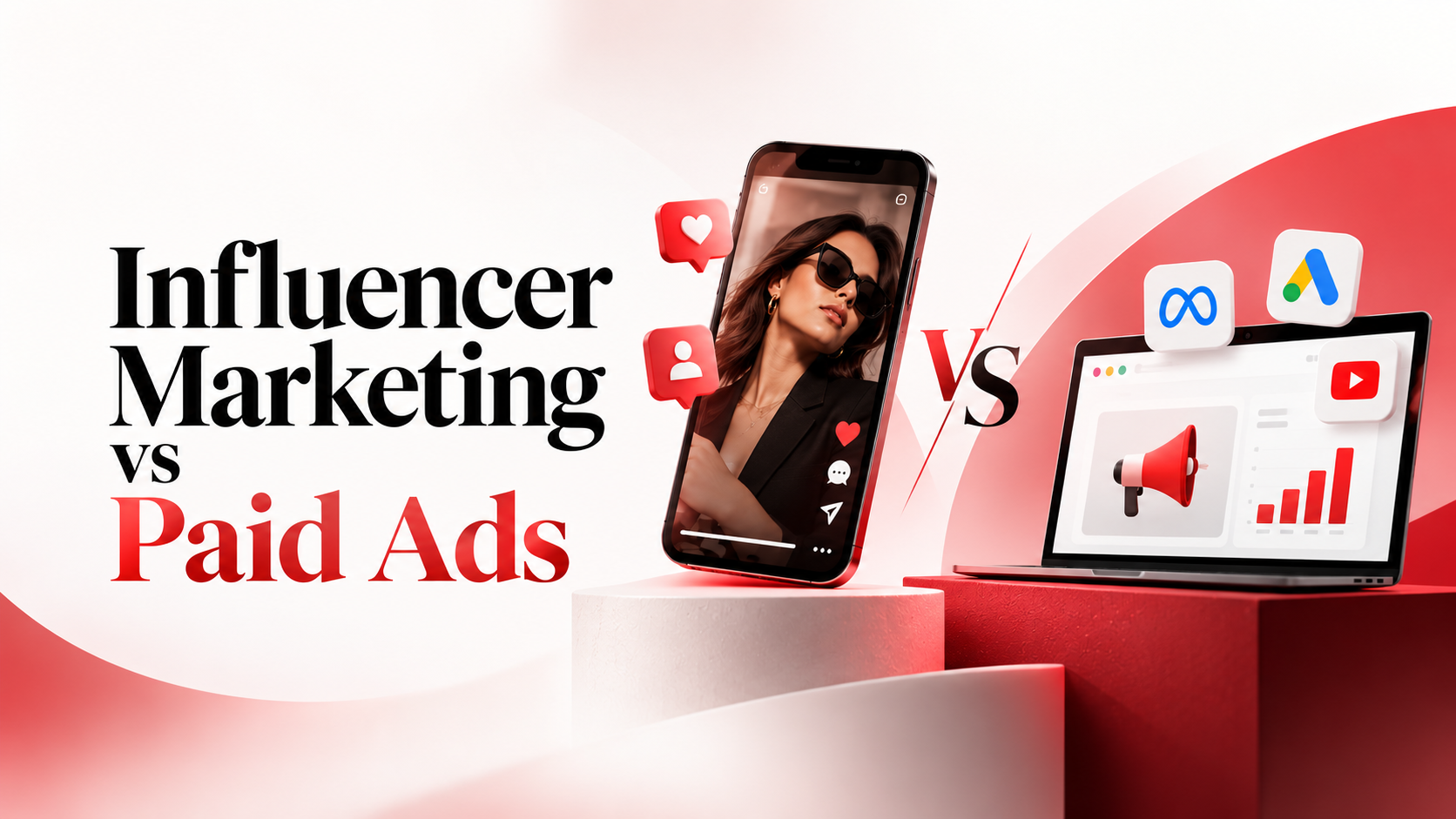
You have ₹10 lakh to spend on marketing. Meta Ads seem obvious they're fast, scalable, and measurable. But if you put all ₹10 lakh into Meta, you might spend the entire budget acquiring 15-20 customers. Put that same ₹10 lakh into influencer marketing with the right creators, and you might acquire 30-40 customers.
The difference isn't magic. It's strategic alignment. Yet most brands never do this comparison. They default to paid ads because they feel safer, more controllable. But in 2026-2027, the data clearly favors a different approach for most Indian D2C brands.
Here's how to decide where your next ₹10 lakh actually delivers better returns.
The ROI Baseline
Globally, influencer marketing returns ₹5.20 to ₹5.78 for every rupee spent. Meta Ads return ₹1.75. Google Ads return ₹2. This alone makes influencer marketing look like an obvious winner.
But India data is more nuanced. Meta Ads delivered properly can achieve 3x-6x ROAS. Well-structured influencer campaigns deliver 2x-6x ROAS. The gap narrows in India compared to global benchmarks. What matters more than the broad comparison is where your specific ₹10 lakh goes within each channel.
Cost Per Acquisition: Where The Real Decision Lives
A D2C brand running Meta Ads typically acquires customers at ₹400-₹800 each. This scales with your average order value, but for most D2C categories, expect to spend ₹400-₹600 per customer in your first months of paid acquisition.
The same brand partnering with micro-influencers (10,000-100,000 followers) typically acquires customers at ₹250-₹350. That's 30-50% lower CPA than paid ads. The difference compounds immediately.
Spend ₹10 lakh at ₹500 per customer through Meta Ads: 200 customers. Spend ₹10 lakh at ₹350 per customer through influencers: 286 customers.
That's 43% more customers for the same spend.
But this comparison assumes equal execution. In reality, most brands execute paid ads poorly and influencer marketing even worse. Execution matters more than channel selection.
When Paid Ads Actually Win
Paid ads work best when you're selling to cold audiences who are actively searching for what you offer. Someone typing "buy organic skincare online" into Google is showing purchase intent. Paid search captures that intent at scale.
Paid ads work best for product categories with high search volume. Fintech, EdTech, and B2B have standardized searches. D2C beauty, fashion, and lifestyle have less defined search behavior.
Paid ads work best when you have creative testing volume. With ₹10 lakh on Meta, you can test 20-30 creative variations simultaneously, measure which performs best, and scale winners. This requires discipline and patience most brands lack.
Paid ads work best when customer acquisition is your singular metric and profitability is secondary. Paid ads will move the needle on customer count. But influencer-acquired customers often have 30-40% higher lifetime value because they arrive with trust already built in.
When Influencer Marketing Actually Wins
Influencer marketing works best when building trust matters more than immediate sales. New brands with no social proof, no reviews, no customer testimonials struggle to convert cold paid traffic. Influencer-sourced traffic arrives with trust already attached.
Influencer marketing works best for categories where peer recommendation drives purchase decisions. Beauty, fashion, wellness, food—these categories benefit from authentic creator endorsement more than performance marketing.
Influencer marketing works best when you want content assets you can reuse. A single micro-influencer post costs ₹5,000-₹15,000 but generates a video asset you can run as a paid ad, embed on your product page, send in email, and repurpose indefinitely. A single paid ad video costs ₹50,000-₹2,00,000 in production costs for equivalent quality. Over time, influencer content becomes substantially cheaper per asset.
Influencer marketing works best when you have time. Influencer campaigns take 4-8 weeks from brief to published content to performance visibility. Paid ads take days. If you need results in 30 days, paid ads. If you can wait 60-90 days, influencer marketing often delivers better unit economics.
The Real Decision: Not Either/Or, But Both
This isn't a zero-sum choice. The best-performing D2C brands in India use both channels strategically.
For early-stage brands (under ₹50 lakh monthly revenue): allocate 70% of budget to influencers, 30% to paid ads. Use influencers to build social proof and content library. Use paid ads to amplify the best-performing influencer content.
For growth-stage brands (₹50 lakh to ₹5 crore monthly revenue): allocate 50-50. Use influencers for brand building and customer acquisition. Use paid ads to scale what's working. Create a virtuous cycle: influencers generate content, paid amplifies it, paid ads are cheaper because influencer content outperforms brand-generated creative.
For scaling brands (above ₹5 crore monthly revenue): allocate 30% to influencers, 70% to paid ads. At scale, paid ads work better because you have the volume to optimize at granular levels. But maintaining influencer partnerships keeps brand equity strong and provides content diversification.
How To Allocate Your ₹10 Lakh
If you're a new D2C brand with no followers, no reviews, no social proof: spend ₹7 lakh on 20-25 micro-influencers (₹3,000-₹5,000 each), ₹2 lakh amplifying top-performing content as paid ads, ₹1 lakh on remarketing to people who clicked but didn't buy.
If you're a D2C brand with existing traffic but struggling conversion: spend ₹4 lakh testing 10-15 creators, ₹4 lakh running the best creator content as paid ads, ₹2 lakh on paid search for high-intent keywords.
If you're a D2C brand with proven product-market fit and positive unit economics: spend ₹5 lakh on paid ads, ₹3 lakh on influencer partnerships for brand building, ₹2 lakh on retention channels (email, SMS, WhatsApp).
The Measurement Reality
Paid ads are easier to measure because attribution is direct. Click → Conversion. Influencer marketing attribution is harder because trust builds over time. Someone sees influencer content, doesn't buy. Sees it again two weeks later, still doesn't buy. Sees it a third time, finally searches your brand and buys through paid search. Which channel gets credit?
Use this framework: measure influencer marketing by cost per acquisition among people exposed to the influencer content. Track via unique codes, UTM parameters, or affiliate links. Don't just measure immediate sales. Measure 7-day, 30-day, and 90-day repeat purchase rates. Influencer-acquired customers often show higher repeat rates, increasing their lifetime value significantly.
Building a growth strategy that balances paid ads and influencer marketing requires understanding when each excels. For most Indian D2C brands in 2027, influencer marketing delivers better unit economics on first-customer acquisition while paid ads deliver better scale at volume. Fame Keeda works with brands to determine the optimal mix for their stage and category, structure campaigns that drive measurable ROI across both channels, and measure performance in ways that account for both immediate sales and long-term customer value. Whether you're deciding how to allocate your first ₹10 lakh or optimizing an existing campaign mix, strategic channel allocation multiplies returns.