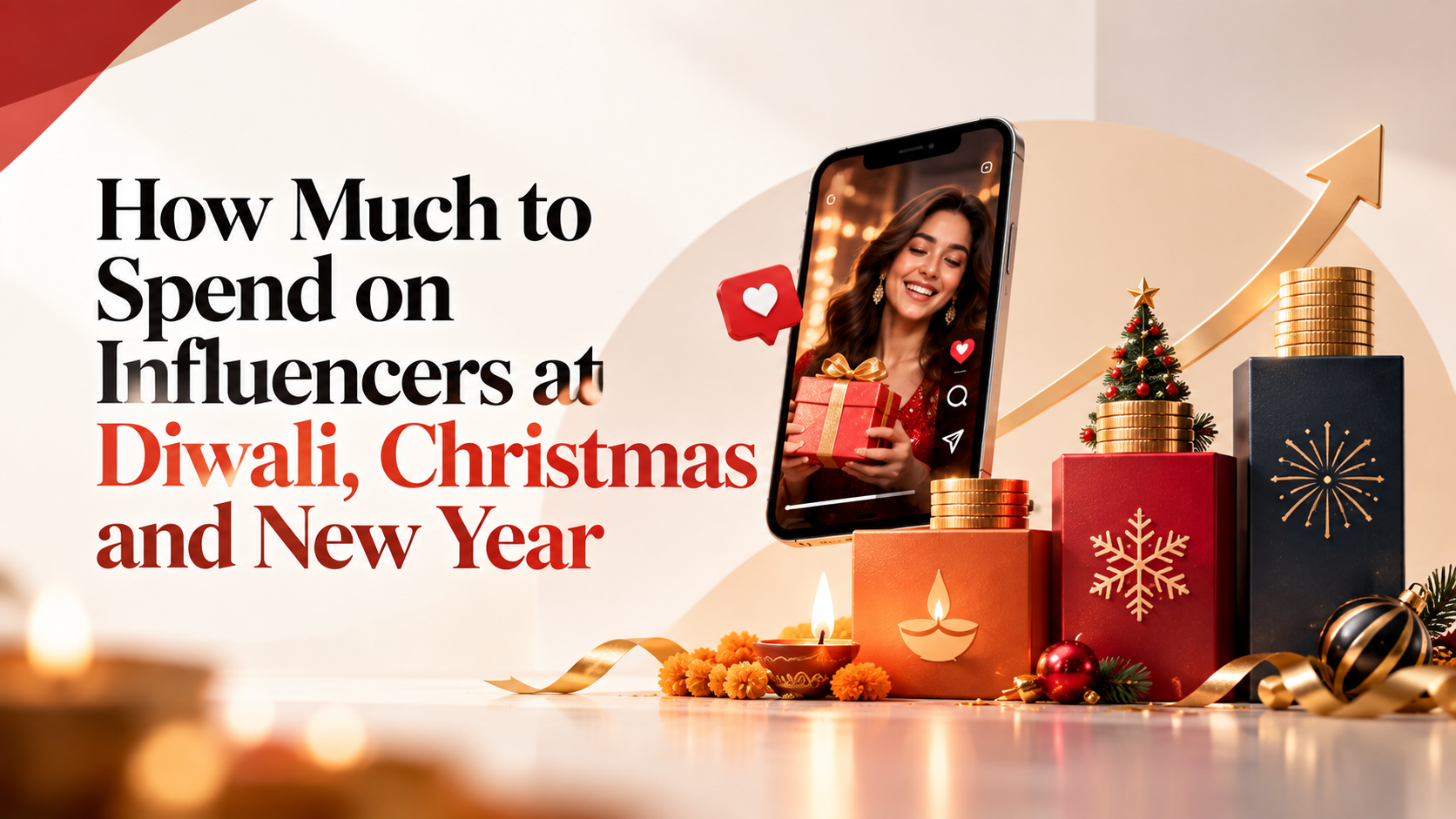
The festive season isn't one campaign. It's three separate competitions, each with different audience mindsets, purchase patterns, and budget dynamics. Yet most brands treat Diwali, Christmas, and New Year as interchangeable—spending the same per creator, activating the same 5-10 influencers, wondering why results differ wildly.
The difference isn't the influencers. It's the budget framework. Each festival demands a distinct allocation strategy because each reaches a different consumer at a different point in their decision journey.
Here's how to budget across all three and avoid burning cash on the wrong festival at the wrong time.
The Festive Spending Reality
India's festive influencer marketing spend reached ₹900 crore in 2026, up 29 percent year-on-year. But this spending is heavily concentrated: the top 10-15 percent of brands account for roughly 65 percent of all festive creator spend. That means 7,200 brands are fighting for creator availability and audience attention. Creator rates rise 20-40 percent during festive windows. Competing for the same creator at Diwali costs 30-50 percent more than booking them in September.
The brands winning festive season aren't the ones spending the most. They're the ones who started planning in August and booked creators when rates were soft.
Diwali: The 49 Percent Festival
Diwali drives 49 percent of all festive influencer marketing activity in India. It's the single biggest occasion on the influencer calendar. But it's also the most crowded. If you're deciding how much to spend on Diwali specifically, start by understanding when to spend it.
Timeline: Plan from August, activate from September
August: Strategy and creator sourcing. Identify 30-50 potential creators across nano, micro, and mid-tier tiers. Rates are 30 percent cheaper than they'll be in October. Lock in commitments from your top 20-25 creators.
September: Early content seeding. Have 5-10 of your confirmed creators post about Diwali gifting ideas, festive styling, or product previews. These early posts warm your audience for the main push and give you data on which creators are resonating.
October 1-10: Ramp-up phase. Activate your full creator roster. Most brands spread ₹30-₹60 lakh across this phase.
October 11-15 (Dhanteras to Diwali): Peak phase. Concentrate 40-50 percent of your total Diwali budget here. Creator rates peak, audience attention peaks, buying intent peaks. But so does the noise.
October 16-31: Post-Diwali tail. 10-15 percent of budget. Target people who missed the main push or are looking for festive exchange deals.
Budget tiers for Diwali:
At ₹5 lakh: Activate 25-30 micro-influencers (₹8,000-₹15,000 each) across three phases: September teaser (7 creators), October ramp (12 creators), October peak (6 creators). Expect 150-200 conversions depending on category.
At ₹25 lakh: Activate 60-80 creators across all tiers: 50 micro (₹8,000-₹25,000 each), 20 mid-tier (₹40,000-₹1,50,000), 10 nano for UGC (₹2,000-₹5,000). Add ₹5 lakh in paid amplification to repurpose top-performing posts as spark ads. Expect 500-800 conversions.
At ₹1 crore: Run an always-on program with 200+ creators continuously. Tier-2 and Tier-3 cities drove performance gains in the previous festive season, so allocate 40 percent of budget to regional creators. Expect 2,000-3,000 conversions.
Critical: Diwali spending should begin in September at low rates, not in October at peak rates. Starting in October means you're booking the expensive creators that already-prepared brands rejected.
Christmas: The Different Consumer
Christmas in India is a smaller festival than Diwali but a distinctly different moment. Diwali is about gifting to family. Christmas is about celebration, parties, corporate gifting, and luxury purchases. The creator mix should reflect this.
Timeline: Plan from August, activate from October
August: Identify creators who resonate with aspirational, celebratory content. Christmas in India skews toward metropolitan audiences, upper-middle-class households, and English-speaking communities. Segment your creator list accordingly.
September: Test early content. Publish 3-5 posts about party planning, gift ideas, and festive fashion from hand-picked creators.
October 1-November 15: Ramp-up phase. Begin main campaign. Most budgets here are 30-40 percent of total Christmas spend.
November 16-December 20: Peak phase. 40-50 percent of budget. Last-minute shoppers, corporate gifting decisions happen in this window.
December 21-31: Tail phase. 10-20 percent of budget. Clearance, exchange offers, year-end gratitude messaging.
Budget tiers for Christmas:
At ₹2 lakh: Activate 15-20 micro-influencers focused on aspirational content (gifting, fashion, celebration). This is smaller than Diwali because Christmas audience in India is smaller. Expect 80-120 conversions.
At ₹10 lakh: Activate 40-50 creators with 60 percent micro-influencers, 30 percent mid-tier, 10 percent nano for UGC. Add ₹2 lakh in paid amplification. Target metros and Tier-1 cities where Christmas has stronger cultural resonance. Expect 300-450 conversions.
At ₹50 lakh: Run a refined program focused on quality over quantity. 80-100 creators with emphasis on lifestyle, luxury, and celebration narratives. Expect 1,200-1,800 conversions.
Christmas budgets are typically 30-40 percent of Diwali budgets for most Indian D2C brands. Don't spend Christmas money like Diwali money.
New Year: The Resolution Machine
New Year is the only festival where purchase intent aligns with self-improvement narratives. Wellness, fitness, education, productivity, personal finance products see their highest conversion rates of the year in the first week of January.
Timeline: Plan from September, activate from November
September: Content strategy. New Year messaging should focus on transformation, goals, and beginning. This is fundamentally different from Diwali (family, gifting) and Christmas (celebration, luxury).
October-November: Seeding and strategy content. Publish educational content, goal-setting guides, and resolution narratives from creators.
November 25-December 20: Build phase. 25-30 percent of budget. Early New Year offers, pre-order windows.
December 21-January 5: Peak phase. 50-60 percent of budget. Resolution purchases happen in this 2-week window. Spending here converts highest.
January 6-15: Tail phase. 10-15 percent of budget. Stragglers and people working through New Year week hangovers.
Budget tiers for New Year:
At ₹1.5 lakh: Activate 12-15 micro-influencers focused on wellness, productivity, and transformation narratives. Expect 60-100 conversions.
At ₹8 lakh: Activate 35-40 creators with emphasis on mid-tier lifestyle and wellness creators (these verticals see higher New Year spend). Add ₹1.5 lakh in paid amplification. Expect 250-400 conversions.
At ₹40 lakh: Run a differentiated program with educational and inspiration-focused creators. Combine product promotion with transformation stories. Expect 1,000-1,500 conversions.
New Year budgets are typically 20-30 percent of Diwali budgets but deliver the highest conversion rates of the three festivals. Fewer consumers but more motivated buyers.
The Seasonal Budget Allocation Framework
Don't distribute festive budget equally. Most brands should follow this:
For early-stage brands (₹0-₹5 crore annual revenue): Diwali 50 percent, Christmas 25 percent, New Year 25 percent.
Diwali is where the volume is. Christmas and New Year matter but are secondary. Put your best resources and biggest budget into Diwali.
For growth-stage brands (₹5-₹25 crore annual revenue): Diwali 45 percent, Christmas 30 percent, New Year 25 percent.
You have enough budget to create distinct campaigns for each festival. Still, weight Diwali highest.
For scaling brands (₹25+ crore annual revenue): Diwali 40 percent, Christmas 35 percent, New Year 25 percent.
At this scale, Christmas becomes nearly as important as Diwali for luxury and aspirational brands. New Year gains prominence for education, wellness, and financial services categories.
The Hidden Cost: When to Start Planning
Most brands plan each festival 4-6 weeks before it hits. At that point, creator rates have already risen 20-40 percent. The brands dominating festive season start planning in August.
August: Strategy and sourcing for all three festivals. Creator rates are soft. You're picking from full rosters.
September: Content production and seeding begins. You test what resonates. You adjust before peak spend.
October-November: Main campaign. You're not guessing. You're optimizing based on September data.
December-January: You're scaling winners, not testing unknowns.
Starting in September (after August planning) costs 30 percent less than starting in October. That's the compounding advantage early planners have.
Minimum Budget to Avoid Wasting Money
A festive campaign below ₹2-3 lakh in creator spend won't generate enough content or reach to tell you anything reliable. You'll spend the same management effort, time, and agency fees, but learn nothing. If your total Diwali budget is ₹1 lakh, you're better off putting it in paid ads than spreading it across 20 nano-creators with inconsistent results.
The minimum meaningful campaign is ₹2-3 lakh on creators plus ₹50,000 in management fees. That gives you 15-20 creator activations, enough content to measure, and enough reach to move conversion needles.
Measuring Festive Campaign ROI
Festive campaigns are high-volume moments that look good on vanity metrics but often hide true performance. Measure by:
Cost per acquisition during each festival window (not total cost divided by total conversions, but creator-specific, daily CPA). Compare CPA across tiers. Micro-influencers should drive 30-50 percent lower CPA than paid ads. If they don't, your creator selection or brief is broken.
Content repurposing value: Track how many of your best organic creator posts become spark ads, and how much additional revenue those spark ads generate. This often represents 30-50 percent incremental return.
Repeat customer rate by creator: Influencer-acquired customers often show 30-40 percent higher repeat rates than paid-acquired customers. Track 30-day, 60-day, and 180-day repeat purchase rates. This lifetime value difference justifies paying premium influencer fees.
The festive season is when brands discover whether they have a repeatable influencer marketing engine or just a lucky campaign. Starting early, budgeting strategically across three distinct festivals, and measuring beyond clicks reveals the truth. Fame Keeda builds festive influencer strategies that treat Diwali, Christmas, and New Year as distinct consumer moments, not interchangeable campaigns. We plan from August so your budget carries 30 percent more force when it's deployed, and we measure ROI through lenses that matter for long-term growth. Whether you're allocating ₹5 lakh or ₹1 crore across the coming festive season, strategic timing and tiered budgeting determine whether you're running campaigns or building seasons.